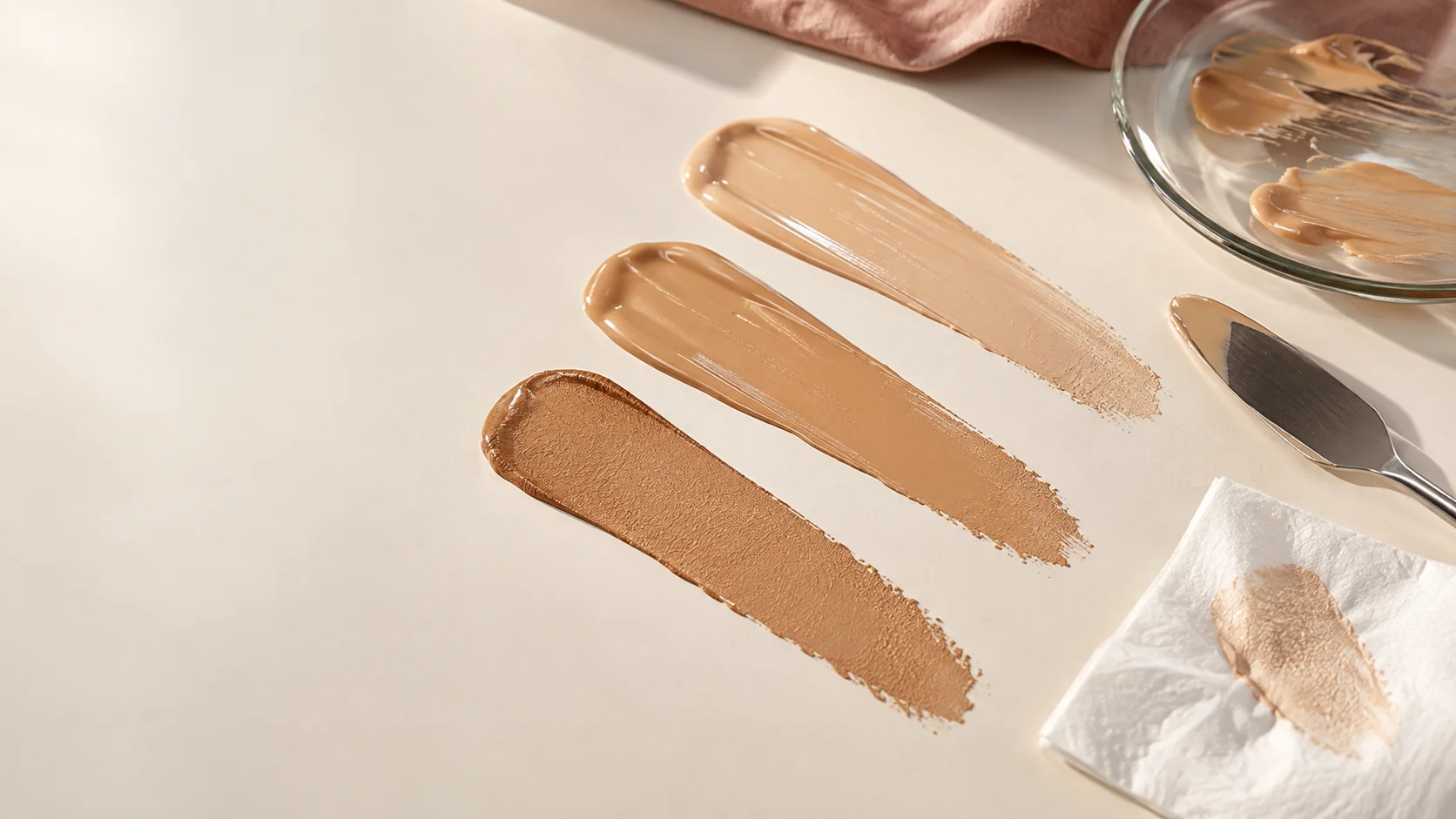
“Matte,” “natural,” and “luminous” describe an intended appearance, but they do not tell you how a foundation behaves while you work. For application, six observations are more useful: initial slip, playtime, leveling, set, film flexibility, and reactivation. They describe when to move the formula, when to leave it alone, and what happens when another layer arrives.
Six behaviors to observe
- Slip: how easily fresh product moves under a consistent stroke.
- Playtime: the usable interval before additional movement begins to lift, streak, or drag.
- Leveling: whether stroke marks settle into a visually even film.
- Set: the point at which the layer resists further movement or transfer.
- Flexibility: whether the dry film remains continuous across expression and texture.
- Reactivation: whether later moisture, cream, or friction reopens the film.
These are observations under defined conditions, not permanent identities. Skin preparation, amount, temperature, humidity, tool, and layer thickness can change the result.
Equal-volume drawdown
Place equal small amounts of two formulas on a clean non-absorbent palette. With separate clean tools of the same type, draw each through the same distance using one pass. Note the starting resistance, width, opacity, and visible stroke marks. Repeat on skin only if the products are suitable for you.
Do not conclude that the longer drawdown is automatically better. High slip can help thin coverage but can also move beyond a precise placement. Low slip may support controlled coverage but demand smaller working zones. The test tells you how to plan—not which formula wins.
Timed blending test
Make three equal deposits. Blend one immediately, one after 30 seconds, and one after 90 seconds. Product labels and formula behavior vary, so these are comparison points rather than universal deadlines. Use the same number of strokes and the same pressure.
If the 90-second patch drags or lifts, work in smaller sections. If every patch remains mobile, delay powder and cream detailing until the film becomes stable. If the immediate patch sheers out while the later patch holds coverage, a short pause may improve placement.
Transfer and reworking
After the surface appears set, press—not wipe—the same clean tissue or blotting material onto each test area with comparable pressure. Record transfer. Then make one controlled pass with a clean tool. A film can be low-transfer yet still vulnerable to rubbing, or transfer visibly while remaining even on the skin.
Next, add a small amount of the cream product you intend to use over it. Press on one side and sweep on the other. Observe whether the base stays continuous, mixes, or exposes skin. This predicts workflow better than a claim that a product is simply “layerable.”
Powder interaction
Apply an equal measured pickup of powder to two identical foundation patches: one early and one after a longer set. Press with the same tool and pressure. Watch for darkening, grabbing, patch boundaries, and excess surface texture. If early powder creates islands but later powder remains even, timing—not necessarily the powder—is the first variable to change.
What INCI cannot settle
Ingredient lists are valuable for identifying declared materials and avoiding known sensitivities. They do not provide a complete manufacturing method, exact percentages for every ingredient, droplet structure, particle treatment, or final film performance. FDA rules also allow ingredients at one percent or less and color additives to appear outside strict descending order. Predict with caution; test the finished formula.
Build a behavior card
For every base, record preparation, amount, tool, initial slip, useful playtime, apparent set time, tissue transfer, response to powder, response to cream, and removal method. Include date and room conditions. The result is a working profile, not a star rating.
Evidence note
The labeling limitation above follows the FDA Cosmetics Labeling Guide. Product safety and individual sensitivity are separate from application performance; stop use and follow label guidance if irritation occurs.
If a layer rolls before these tests can begin, return to Why Makeup Pills. If the film looks stable but the shade looks wrong, continue to Undertone Is Not Enough.